

Content Marketing: The Most Popular Form of Internet Marketing Today. Why is content marketing so popular?
Unlike other online marketing techniques, the pharmaceutical industry can boast of its contribution to the foundations of this highly effective form of reaching customers.
The pharmaceutical industry is not particularly known for its innovation in the world of modern marketing. However, it has played a significant role in building the foundations of contemporary content marketing. The pharmaceutical industry was the first to lay the groundwork for content marketing based on opinions expressed by patients, pharmacists, and practicing doctors. These opinions become a source of knowledge for subsequent patients, pharmacists, and doctors.
The Patient-Doctor Relationship
Patient-doctor relationships have undergone significant transformations over the centuries. They used to be paternalistic, with a huge advantage held by the doctor over the patient, starting from the use of Latin in communication to the patient’s role in the entire treatment process.
In 1882, Robert Koch noticed that when patients did not follow medical advice, the therapy did not yield the expected results. The foundation for the concept of “compliance” (the patient’s adherence to medical advice) was established in 1970 by scientists at McMaster University Medical Center. They pointed out that non-compliance is costly for both the patient and the healthcare system and is the most important factor hindering the treatment of chronic diseases.
Dr Google
The advent of the internet has revolutionized all aspects of human life, including health. The internet has begun to have an increasing impact on patient behavior. The term “Dr. Google” has become widespread. The internet is used for diagnosing symptoms and searching for information about diseases. It has become a broad platform for the free exchange of opinions about diseases, their diagnosis, and treatment. Never in history has a patient had such easy access to medical content and “self-diagnosis.”
Patient Education
According to the Megapanel PBI study by Gemius, the internet is the most frequent source of health information. The next most popular sources are doctors and pharmacists. The number of internet users searching for medical content online continues to grow, currently exceeding 93%. The increasing access to the internet, related to the development of mobile devices, suggests that soon every patient will use “Dr. Google” when making self-treatment decisions.
The growing trend of using the internet to search for health information is a fact that cannot be ignored in the modern treatment process. The result is recognizing valuable medical content and skillfully using it to make proper health decisions. In collaboration with academic centers, we promote the basic principles of Evidence-Based Medicine (EBM). We also assist in developing educational programs aimed at specific patient groups, aiming for better patient-doctor cooperation. We highlight the current importance of “Dr. Google” as the first point of contact for medical advice.
The Role of the Internet in Health
Analyses have shown that patients’ motivation to seek medical content online increases with the severity of their symptoms. Due to the growing access to the internet and the rise of lifestyle diseases, the number of people using the web for “self-diagnosis” and making treatment decisions increases yearly. Patients use the internet to actively participate in their treatment.
However, the internet, alongside its positive impact on health education, also has negative effects. It is a medium where one can find many unreliable sources. It is often considered a “junk medium.”
The evolving patient-doctor relationship and the increasing importance of the internet in treatment compel drug manufacturers to change their approach to modern forms of promoting medicinal products, drugs, and therapies.
Zero Moment of Truth
The Zero Moment of Truth (ZMOT) is a purchasing process described by Google, characteristic of the modern world. It involves the user seeking information or consulting it via the internet at every stage of decision-making. This makes the user an informed partner in discussions with doctors and a mere buyer in the pharmacy.
Preparing useful and easily accessible content and publishing it online are the key elements of the content management process. They help gain the favor of the internet user and facilitate their “purchasing” decision.
Content marketing is not just about producing and placing content online – it is primarily the art of meeting customer needs. Therefore, our copywriters, web writers, PR specialists, and collaborating doctors, specialists, and opinion leaders participate in the content creation process.
The Patient’s Online Journey
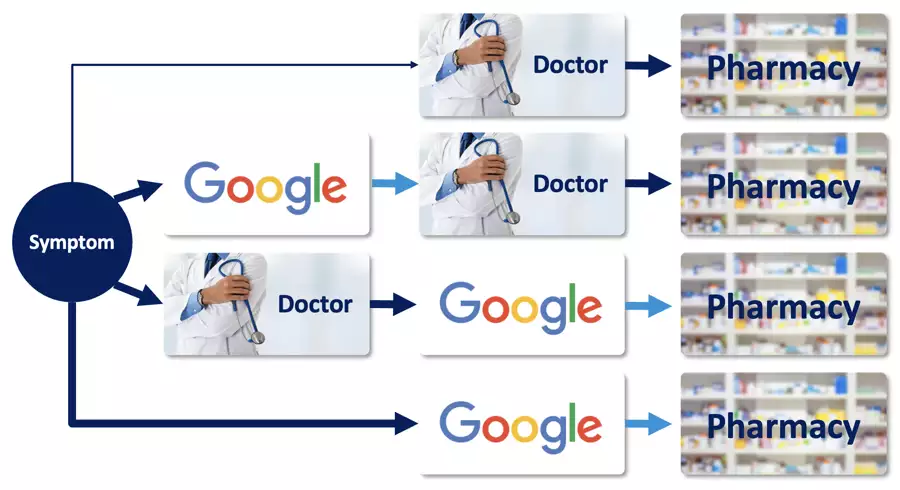
A few years ago, to buy products or services, a patient had to visit a doctor. After diagnosing the illness, the doctor prescribed/recommended the appropriate therapy, and the patient purchased the medication at a pharmacy. This path was straightforward: SYMPTOM – ILLNESS – DOCTOR VISIT – PHARMACY PURCHASE. Patients could only comment on the effectiveness of the drugs after using them.
Today, this process looks entirely different. Due to the increased access to the internet, the consumer – the potential patient – is no longer passive and solely reliant on the doctor’s verdict. Today, they seek information and answers to health-related questions, check what is being said about treatments online, and confirm diagnoses themselves.
Content Marketing
This is why the role of content is so crucial, particularly its reliability, usefulness, and accessibility. The task might seem simple at first glance. However, when preparing a content management strategy, it is essential to answer a few basic questions: Who is our audience? What can they currently find online? What opinions are expressed by internet users on the topic of interest? What is the purpose of posting the content, and where do we want to place it?
Content on the internet is not just articles or news found on educational or informational portals. Content also includes comments from internet users who evaluate products and share their experiences using them. The most common place for such spontaneous comments is online discussion forums.
An essential element derived from fundamental marketing principles is the need to understand the current situation by examining the availability of content online. This is one of the first elements of creating a marketing plan. The next step is to plan further actions.
Everyone involved in pharmaceutical marketing should note that every internet user searching for knowledge is a potential patient. The most crucial task is to provide reliable information in places where they will likely find it online. It is essential to be constantly present on the “online paths” of the patient.
The three pillars of internet marketing
The three pillars of internet marketing, where content plays a key role, are:
- Searching, where Google plays a crucial role;
- Websites (portals, vortals, corporate and product sites), blogs;
- Social media platforms.
Summary
In summary, content marketing is currently the most popular form of online marketing, with its roots in the pharmaceutical industry. The internet provides patients with easy access to health information, transforming their relationships with doctors and their decision-making processes regarding treatment. The key to content marketing is providing reliable, useful information that supports informed patient decisions. Pharmaceutical companies must adapt their strategies to the changing landscape, considering the significance of the internet and the concept of the Zero Moment of Truth (ZMOT).
The internet and patient behavior online have become the foundation of a new era in pharmaceutical marketing.